This is a record of Burn After Meeting 2024.
Contents
Burn After Meeting 2024 Public Information Report
Basics
Burn After Meeting 2024 was held at the Hilton Orrington Hotel in Evanston IL USA, October 26–27.
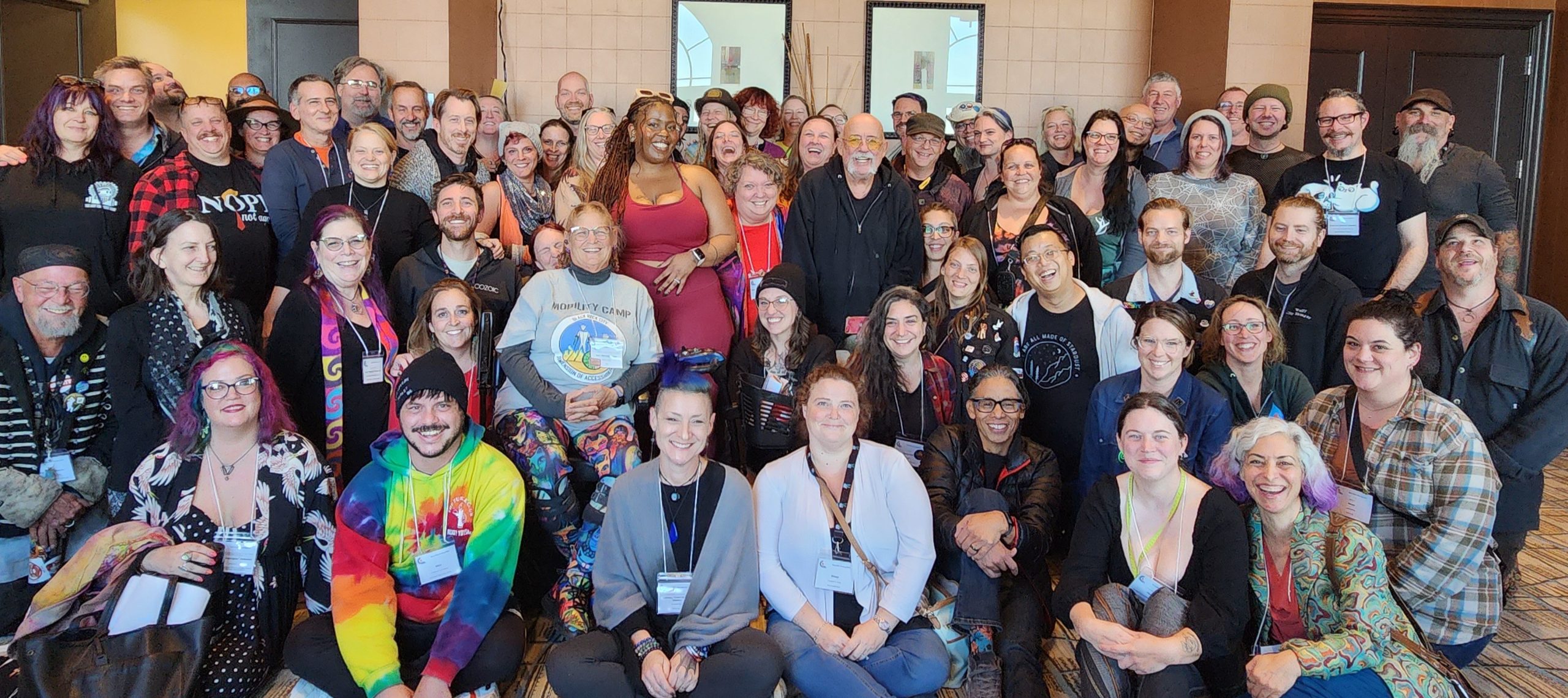
115 people representing at least 19 entities participated.
Ticketing
There were two phases to the ticketing process:
- A crowdfunding campaign to meet the conference’s basic funding goals. These tickets cost $150.
- General sales after the crowdfunding campaign ended. These tickets cost $185. Buyers could either purchase a ticket for themselves or vouchers for others.
The crowdfunding campaign ran from Jan 24 to Feb 22. The campaign’s target amount was $13,500; it raised $18,600 (not deducting the Indiegogo 8% fee), for 122 tickets (plus a very small amount in donations below the price of a ticket). The goal of the crowdfunding campaign was to meet the conference’s upfront costs in advance, and it succeeded in that.

Backers of the crowdfunding campaign were sent vouchers that they could redeem for tickets. Vouchers were also available for sale during the general-sale period. There were a total of 135 vouchers (as opposed to tickets) sold, either during the crowdfunding campaign or regular sales. Of these, 91 were “group buy” tickets, where one person or organization bought multiple vouchers, anywhere from 2 to 10.
During general sales, an additional 32 tickets or vouchers were purchased. All of the regular-sales vouchers were redeemed.
31 of the crowdfunding-campaign vouchers were never redeemed, though for planning purposes, they were treated as if they would be redeemed at the last minute. Some backers let us know that they were treating their ticket as a donation; some had purchased vouchers on spec for members of their organization, and then had trouble finding anyone who could use them. For the most part, we never heard from the no-shows.
About five tickets were transferred.
Refunds were available until two weeks before the conference—this was the point when the catering order needed to be finalized. Two tickets purchased during the crowdfunding campaign were later refunded, not counted in the numbers above.
Setting the ticket price was a tightrope walk. I wanted it to be as cheap as possible, but no cheaper; I wanted the general-sale ticket price to be a big enough delta over the crowdfunding price that it provided a real incentive to buy early—the only way the conference would go forward—without seeming punitive. I had set the crowdfunding target as 90 tickets-worth. I set the price in the expectation that I’d barely meet my crowdfunding target and would sell more tickets in the general sale; obviously the reverse happened, but apparently I was bad at estimating how much I’d need to cover expenses, so I wound up farther ahead than expected.
It is an interesting coincidence (but not really more than a coincidence) that the conference’s profit of $4700 is almost exactly the value of the unredeemed vouchers.
I do plan on using a crowdfunding campaign to get BAM 2025 off the ground. Considering the number of burn orgs that had “eyes bigger than their stomachs” in ’24, I expect group buys to be smaller on average next time.
Programming
All of the programming was sessions proposed by participants; the organizers were almost completely hands-off in this regard, apart from suggesting to two people who proposed very similar sessions that they combine their efforts—which they did—and that a person with subject-matter expertise be added to another session—which she was.
One presenter had to cancel at the last minute for personal reasons. Conversely, we added one session after the program had been printed, and another one at the event.
The conference opened with brief remarks by Adam in the hallway outside the function rooms followed by an icebreaking exercise in which signs naming ten topics were taped up in the hall outside the meeting rooms, and participants gathered at the topics that interested them to meet people of similar interests. This was the same format as used in 2023, where it seemed to work well.
After that, Saturday had four sessions in parallel and three 85-minute time slots; Sunday was 4×4. There wound up being two holes in the schedule grid.
Sessions topics tilted toward event safety: out of a total of 26 sessions, five were focused on safety volunteers, and another three were arguably safety-adjacent. Three were by burners who own technology companies that provide services related to burn events (Dust, BRCvr, and Volunteeripate). Four focused on abstract, big-picture questions. The rest were more operationally focused in one way or the other.
Eleven of the sessions were explicitly roundtable discussions; a few of the presentations wound up being roundtable discussions, at least in part. All of the presentations included plenty of time for Q&A.
In addition, there were six “dine around” dinners, each with about eight participants. These were patterned after the dine-arounds at the 2024 European Leadership Summit. Each had a “table captain” who made dinner reservations and picked a specific topic of conversation for their table.
My impression, which is corroborated by some of the questionnaire feedback, is that the roundtables were run a little too loosely this year. Last year this wasn’t a problem that I noticed, and perhaps I grew complacent. I suspect that some of the roundtable facilitators just didn’t read the roundtable meeting guide or didn’t take it seriously. Something to tighten up on for next year.
One criticism of some of the roundtables is that they were little more than “status checks”—that is, a person from each burn saying “this is what we do.” There is some value in that, but we should make sure that the facilitators think about whether that’s what they want, and appropriately describe their sessions for the benefit of would-be participants. We should also work with facilitators more closely to make sure they understand the importance of having a stack keeper, and to help them focus their topics of discussion.
Some roundtables were trying to cover too much ground. Next year, the organizers should work with roundtable facilitators to A) make sure they run a tight ship, and B) tighten up their focus.
People representing Freezerburn TX ran a total of five sessions. Lakes of Fire had people in seven sessions (sometimes on panels with people from other orgs), which is a little less noteworthy considering BAM was in their backyard. This imbalance was called out in questionnaire responses from a couple of participants.
I should have recruited some speakers for “bread and butter” topics. I think that would have improved the mix of programming.
There was a party on the Saturday night of the conference in Old Town, about an hour away by El. This is a regular Burner get-together that either was coincidental with BAM or had been rescheduled for BAM. Because of the distance, not a lot of people went, and some people thought that the BAM organizers had made the mistake of organizing a party that was too far away.
I did not do a great job coordinating the dine arounds. I should have given the table captains a fixed time and place for their diners to rally, but left that up to them. I suggested a reservation time, which I later changed due to the party in Chicago. From what I’ve heard, the people who took part in dine arounds thought they were successful.
Some people reported that 85 minutes was too long for a session, some felt that they could have gone twice as long, depending on the topic. Several people mentioned that 5 minutes between sessions wasn’t enough.
Communications
Pre-event communications between the organizers and participants were via e-mail.
The organizers set up a Discord server for use by the participants, with a general chat channel, a roomshare/rideshare channel, and separate channels for each session. None of these were used much before the conference, but they were used very intensively during the conference, to share documents mentioned during sessions, to share recordings that participants made of the sessions, to organize dinner outings, etc.
The organizers had a Signal group chat that was the primary medium for planning discussions.
I have some misgivings about Discord. It doesn’t really give much control over server membership. It seems to be based on the idea that a server will be more or less public (even though it does nominally allow for private servers), so it offers good tools for banning or muting bad actors, but doesn’t give tools for managing the membership of a private server. People have a single identity across different Discord servers, and don’t need to connect to their default-world identity in any way. Compared to Slack, it does have more powerful options for organizing discussions, and doesn’t hide them after 90 days. So its pros and cons are almost perfectly complementary with Slack.
Discord has a juvenile aesthetic, and is perceived as being the province of The Young, but they do let old farts use it.
Venue
The Orrington is a historic hotel in downtown Evanston, just north of Chicago. It is walking distance to a stop on Chicago’s El system, and is surrounded by restaurants, coffee shops, retail, etc. It is a few blocks from Northwestern University.
The conference occupied four rooms on the hotel’s 9th-floor conference center, along with a wide hallway connecting them.
I thought the hotel was great. Nice facilities, mostly good service, although there were a few hiccups. It was a little weird they were doing maintenance work on the conference-room floor during our conference—even working on the trim around one of our conference room’s doors.
It’s a lucky thing that I liked the hotel, because I didn’t really have other options. I had also looked at Albuquerque, and couldn’t get any of the hotels there to call me back. I looked at Chicago, but gave up on that when I found that the only hotels that could accommodate us were big downtown hotels, which would have been a comparatively inhospitable environment. I looked at Evanston, since it is well-known to me, and of the three hotels that (on paper) could host us, only the catering manager at the Orrington would call me back.
Hotels, and all the ancillary services (catering, AV) are expensive, but from what I’ve found, there aren’t a lot of venues that can accommodate a conference other than hotels out there, and those are expensive too.
At BAM last year, a Colorado RC really helped out and lined up local burners who could lend me TVs for the presenters. I didn’t have much luck with that this year, although I did put out a call for help. One presenter brought his own projector, another had a tiny and not very useful projector. This was another place where my coordination was not great—I hadn’t gotten firm commitments from people who mentioned they might bring projectors, when to hand them off, etc. What we discovered, though, was that all the rooms had projectors mounted to the ceiling, there were retractable screens in all the rooms, and a remote that would control the projectors in three of the four rooms had been left out in the open. I’d received a $7000 quote from Encore (the AV services vendor) to put projectors in the rooms, so that was a $7000 remote. You can find identical ones on ebay for about $11.
A side note about projectors vs TVs: Even good projectors require that the house lights be dimmed. TVs don’t need this. I think that having the lights on changes the back-and-forth between the presenter and audience for the better, so ideally, we’d use TVs. They’re pretty cheap these days.
The host city of Evanston prompted a variety of feedback. Some people wished it had been in Chicago so they would have been closer to everything; others recognized that Chicago would have been more expensive. One told me she felt safer in Evanston than she would in Chicago, which counts for something. I thought that downtown Evanston was a good option beforehand and I continue to think so. It’s human scale, with lots of dining options within walking distance.
Catering
The hotel catered breakfast and coffee both days of the conference. Breakfast was breakfast burritos both days. This was served in the hallway.
Catering is excruciatingly expensive for what you get. An 8-oz cup of coffee winds up costing about $10. Breakfast burritos about $23. You’re paying for the convenience and the fact that you’re a captive audience.
Nevertheless, I do believe that providing breakfast—especially coffee—is important. It gets people together in the same place before the first session and provides an extra socializing opportunity.
Program
Roundtable Meeting Guide
Roundtable discussions do not have a presenter speaking to an audience; everyone is participating on an equal footing. In order to make this work, we need some tools and ground rules. Some of these will probably be familiar.
Facilitator
The facilitator presents the topic of discussion, keeps it on track when people seem to be veering off course, and can inject ideas to keep it moving if it seems to grind to a halt. If a small number of people are dwelling on a trivial issue or monopolizing the conversation, the facilitator should invite them to “take it offline.”
The facilitator can voluntell someone to be stack keeper.
Stack Keeper
In order for everyone to have a chance to say their piece, they raise their hand or otherwise get the attention of the stack keeper, who maintains a written list and calls on people in turn.
It is a good idea for the facilitator to break the session into 3–5 sub-topics. At the beginning of each sub-topic, the facilitator will introduce it and the stack keeper will go around the room to add people to the stack; the stack keeper can go around the room again after that sub-topic is about halfway through so that people can get on stack to respond to points raised during the first half of that discussion.
Side Stacks
If a topic arises during discussion that people want to focus on, the facilitator can suspend the stack and have the stack keeper open a “side stack” in order to focus on that topic. When the side stack has been cleared, the facilitator returns to the main stack.
Time
No need to be strict about time, but each person should limit their speaking turn to about two minutes.
Jumping Stack
“Jumping stack” is speaking out of turn. The facilitator should shut this down whenever it happens except for points of information.
Point Of Information
If a speaker is saying something based on incorrect information (not a matter of opinion), or has asked for clarification, someone else can jump in to clarify. When you are jumping in without invitation, begin by saying “Point of information…”
Points of information should be kept short so that the previous speaker can get back to what they were saying without being derailed. Do not interject points of information just to add asterisks to what someone else is saying.
Twinkles
Rather than getting on stack just to express agreement with what someone else has said, participants can hold up their hands and wiggle their fingers to show agreement.
No Personal Attacks
You can criticize another person’s idea, but don’t criticize the person.
Don’t Use Up All The Air In The Room
If you’ve already spoken, give other people a chance to speak before getting back on stack.
Sessions
Saturday
08:00–9:00
Breakfast & coffee
09:00–10:25
Plenary session: ground rules, get acquainted
10:30–11:55
Sustainability At Regional Events
A roundtable discussion exploring how Regional Events can engage in the work of the Burning Man 2030 Environmental Sustainability Roadmap. We’ll discuss a few frameworks from which we could engage in this work, such as Power, Water, Food, Waste, Structure and Transportation including strategies to become zero waste, carbon negative, and to regenerative.
This session will give space to both – share your ideas and learn how you can make actionable steps towards greener events and what new practices we might see in the future. Regional Events have the opportunity to outpace and even beat Black Rock City to its own sustainability goals–let’s explore how we can do that work together.
- Room: James
- Presenters: Breedlove
Newbie Acculturation
For many burners, regional events are their first touchpoint with Burning Man. At SideBurn, we’ve noticed that we have a lot of newbies coming to our regional as their first burn that don’t know what to expect. How can we ensure that new burners are welcomed and understand how a burn is different from a commercial festival, and how can newbies be encouraged to fully participate?
We’ll talk about some strategies we’ve discussed and used – one of our board members led an amazing newbie tour, for example – but the majority of this session will be open discussion and a participant-driven brainstorm session.
- Room: Bonbright
- Presenters: Leanne “Phoenix” Unruh
Fire Safety: The View From 10,000 Feet
An abbreviated Powerpoint deck and Q&A as presented at the Burning Man GLC and SERT. Starting with the basics of Tort Law (what are you actually liable for, and why?) then continuing on to techniques of Risk Management, and how to communicate your efforts to permitting agencies and insurers.
- Room: Rogers
- Presenters: Eric “Eric G” Griswold
Regional Ranger Roundup
Presentation:
- Current Topics
- Building a new shared training & online training — a project to extract common elements from many ranger trainings for distribution out to regionals to lower the time commitment to making new trainings, and a project to create a recorded version of that training for Hive.
- ART of Regional Rangering — a project to make a document to make it easier for rangers to move between regionals.
- 25 to Thrive
- Vouching System — how we’re using the vouching system to help rangers move between regions.
Roundtable:
- How are folks’ ranger teams going?
- What resources should we work on together in the coming cycle?
- Talking about Incidents
- Room: Cummings
- Presenters: Corprew “Zeitgeist” Reed
Noon–13:55
Break for lunch
14:00–15:25
Site Ops/DPW – Building The Canvas
Bulding the Canvas — Are you part of setting up infrastructure for your event, whether you call it DPW or Site Ops or any other name? Let’s talk about how we do it, how not to do it, vendor shenanigans — anything related to getting your burn up and running before it’s overrun with burners and torn down after the burners have had their time. What departments do you have set up? What kinds of infrastructure does your burn provide? What went right or wrong for you this year or last year? How do you acquire and retain your volunteers and leads? What are some special circumstances of your burn?
Come talk through your burn event prep with other Site Ops volunteers and leads and learn about best practices and how not to do it. Bring your event planning details to share! “If you wish to make an apple pie from scratch, you must first invent the universe” — Carl Sagan
- Room: James
- Presenters: Robin “Bossy Spice” McShaffry
Rebuilding A Fractured Community: A Case Study And Discussion
Communities grow and change in ways that its members don’t always feel represents them. It is human nature that resentments and factions begin to form. What do we do as community leaders to address concerns? What if disagreements can’t be accommodated? There’s a lot that happens when humans human as hard as we do. We’ll do a case study of the San Diego Burner community which has been vibrant since the early 2000s and grew to a regional with over 3500 attendees. We’ll examine how a community in distress got smaller, redirected and is starting to flourish again.
- Room: Bonbright
- Presenters: Cable King
Codes Of Conduct
This will be a panel discussion of the histories of codes of conduct at Lakes of Fire and AZ Burners, their processes, where they’re at now, and what challenges they still face. Also timelines for wrapping up cases, and how people who have been banned can make their way back. And also discussions on sharing information so that predators find it increasingly difficult to go from one regional to another. – Room: Rogers – Presenters: Eric “Pirate” Branson, Lisa “Sassy Cat” Scheinkopf
15:30–17:00
Keeping The Experiment Alive
At FreezerBurn TX, we’ve tried to maintain a spirit of experimentation in how we do things. Not everything is a success, but that’s the point of experimenting! We’ll talk about a few of the things we’ve done and what worked that we kept doing. We can dig into particular experiments that y’all want more info on, but then want to hear what you’ve been doing and how it’s gone for you! – Room: James – Presenters: Pitter Patter, Doc Holliday, Greg “Wulff” Swift
Volunteeripate – Burn Data Like You’ve Never Seen It
Dive Deep into Burn Data Like Never Before! This year, Volunteeripate is unlocking the secrets of burn events on an unparalleled scale. Get ready for a look into anonymized data from participating organizations. We’ll be uncovering insights on:
- The ticket sales secrets: What drives a burn to become a hot commodity?
- Volunteer Engagement: See how burns utilize volunteer hours to drive their event.
- The Event Ecosystem: Gain a holistic view of burn data, revealing the unseen connections that make burns thrive.
Join us and unveil the hidden patterns that make burns thrive!
- Room: Bonbright
- Presenters: Cabbie
From Flames To Claims: Navigating Insurance For Burning Events
We’ll define the terms and concepts you need to know and take an in depth look at two example policies, explain the key differences of each, and talk about what you need to know to reduce your liability. What coverage do you want to make sure you have based on real experiences? We’ll be joined by two veteran burner-brokers who have helped procured policies through Lloyds, Kinsale, and others for regional 10-principal events. Chances are good you’ve worked with one of them before. A 30-min presentation will be followed by a discussion / Q&A.
- Room: Rogers
- Presenters: Anton Erik “Valemon” Vogt, Courtney “Deere Bringer” Weidner, Rick Diaz
Bring Out The Best In Others
Bringing out the best in others is a crucial skill, as it fosters growth, confidence, and collaboration. By empowering people to reach their full potential, you not only improve performance but also enhance the overall success of a team or community. When individuals feel supported and valued, they are more likely to contribute creatively, take initiative, and work effectively with others. This workshop will teach strategies that encourage mindfulness and helping those around you.
- Room: Cummings
- Presenters: Alesia “Mother Unit” Clardy
Sunday
08:00–9:00
Breakfast & coffee
09:00–10:25
Mental Health First Aid At A Burn. Are We Doing It Right?
Let’s gather and share notes about our burn’s CIT & Sanctuary programs. The landscape of mental health has been challenged since the pandemic and we should talk about it. By openly discussing our successes and failures, perhaps we (management) can all move forward with a little less stress.
- Room: James
- Presenters: Joel “LoveRhino” Eastland
Social Media, The Good, The Bad, And The Oh Hell No!
Join one of the Info_Bot leads from Lakes of Fire to discuss what works, what doesn’t, and what makes your skin crawl with regard to social media.
One of the biggest challenges for any event organizer is how to manage creating a community and space outside the burn and how to manage the chaos that it can sometimes bring when context is everything and posts on spaces like Facebook quickly spiral when not enough context is given. We want our communities to have a voice, but that often means being vigilant on social media yourself to ward off any issues that might arise. This conversation will focus on the guidelines that each of us put in place, what works and what doesn’t, how to maintain and engage a community, and how to grow one if that is what you are hoping to do.
- Room: Bonbright
- Presenters: Jessica “Cuddlefish” Smith
Mobility: Everyone Gets A Burn
A short presentation on how a couple of unused golf carts at LoF DMV and frustration at watching folks struggle developed into a program that has been embraced by the community and grown beyond anything that could be imagined, except at a burn. Radical Self Reliance is also knowing when to accept and offer help. We are hoping to keep the presentation short to allow for Q/A and hearing about similar efforts at other regionals
- Room: Rogers
- Presenters: Eric “Pirate” Branson, Adam “Familiar” McAleavey, Dani “Rat Lady” Moore
10:30–11:55
How To Train Your Actual—Care And Feeding Of Volunteer Leaders At All Stages Silly title aside, we want to have a very real and frank conversation about the volunteer leadership lifecycle at burns and how we can keep our people-powered events truly sustainable. We’ll discuss: How can we introduce folks to the concept of leadership and organize leadership roles in a way that sets the right tone? Once folks are settled into their leadership roles, how can we make or keep the positions fulfilling and fight burnout? And, when folks are ready to step back into participant roles, how can we respect and support that while demonstrating that we value their contributions and knowledge?
- Room: James
- Presenters: Jimmie “WiFi” Lundie, Doc Holliday, Pitter Patter
Civic Responsibility And Community Engagement = Civic Engagement And Community Responsibility?
The 2023 State of the Regional Network Report stated that only 32% of regions reported conducting civic projects in 2023. Yet according to a survey conducted by Burning Man Project in 2024, 42% of respondents indicated that they wanted to see more civic projects in the Regional Network. With this much interest, why are there so few civic projects? Through this facilitated roundtable discussion, we’ll explore some specific past examples of recent projects and discuss the kind of projects you’d like to see in your own community and what it might take for those ideas to become reality.
- Room: Bonbright
- Presenters: Patty Simonton
Guerrilla Emergency Management
Burns come in all shapes and sizes with different needs when it comes to Emergency Preparedness. The task of keeping our Burns Safe is no small task regardless of the event size.
In this session we will discuss:
- Evaluating the needs of your Burn.
- Starting new safety related departments.
- Growing existing safety departments.
- Safety Related departments and how they work together. (Fire/EMS, fire art, Ranger, Gate, Radios, Information, BOD, etc.).
- Partnerships with other burns.
- Volunteer recruiting and retention.
- Leadership Chain development.
- … and putting it all together.
- Room: Rogers
- Presenters: Joel “LoveRhino” Eastland
Documentation Talk
In this session, I will discuss some general principles for writing and organizing documentation, focusing mostly on internal documentation for a burn org, and introduce a system based on open-source software for producing documentation that embodies these practices.
- Room: Cummings
- Presenters: Adam Rice
Noon–13:55
Break for lunch
14:00–15:25
Relationships Between The Board, Event Organizers, And Departments
This session will be a facilitated discussion about different models regional burns use to define the powers and responsibilities of the board, event organizers, and departments. The goal is an open discussion about the challenges you face in these relationships, how those challenges were addressed, and how that went well, or did not. Additional areas of focus will include resolution of inter-departmental and inter-lead conflict, delegation of responsibility, maintaining continuity of leadership, and “Should this management process be a ThunderDome fight?”.
- Room: James
- Presenters: Jared “Epic Fail” Granberry
Safety Volunteers
The issue at hand is the recruitment and retention of safety volunteers, that is, professionals in the safety area that make the waivers we sign at least minimally viable. How do we increase this specialized pool of volunteers when general volunteerism is down and how do we keep them engaged once we do.
- Room: Bonbright
- Presenters: Renegade
Fun With Finance!
Accounting, finances, budgets…..these are an UN-fun, but necessary part of organized burning. Every burn has reporting requirements – be it to the community, BORG, taxing authorities or other. We’ll cover the basic structure of financial statements, including burn-specific considerations. We’ll also talk about setting and reporting on budgets. Bring your questions and thoughts for an interactive session. No financial or accounting knowledge necessary to attend! This session is all-inclusive for anyone interested in learning more. And we’ll make it FUN!
- Room: Rogers
- Presenters: Jennifer Heath
BRCvr Presents BurnerSphere, Update And Q&A
Join creators Athena Demos and Mike Heath for an engaging talk and Q&A about BurnerSphere, an official virtual Burning Man experience, the groundbreaking immersive app that brings the essence of Burning Man’s Black Rock City into virtual reality. In this session, you’ll not only learn how BurnerSphere allows users to explore interactive 3D environments and 360/180 video footage while socializing with friends, but also get an inside look at the process of capturing large-scale art at Burning Man and creating detailed 3D models using photogrammetry. Discover how your local burner community can participate and bring this unique digital experience to your events, fostering deeper connections with Burning Man culture year-round.
- Room: Rogers
- Presenters: Athena Demos Mike “Big Mike” Heath
15:30–17:00
The Rent Is Too Damn High — Burns? In This Economy??
Economic inequality is growing. The tech sector is a mess. So, as community-experiment-minded event organizers, what are we going to do about it? Let’s talk! Our moderated, interactive group conversation will be sure to touch on the impact on both participants and on orgs.
- Room: James
- Presenters: Renegade, Pitter Patter, Doc Holliday
What If Burning Man Is A Cult? What If That’s Ok?
This moderated open discussion will focus on what the key markers are for the definition of a cult, whether Burning Man fits into that category (it does). As leaders, what does that make us? Are we cult leaders? Is that necessarily a bad thing? What should we do about it?
Can we embrace this definition and still promote the 10 principles, lead with integrity, and transparently ac-cult-urate new members?
- Room: Bonbright
- Presenters: just ben
Flame Effects Artist Guild
Flame effects artists are a huge part of the Burning Man and Regionals community, and we are at the forefront of a brand new art form! The newly formed non-profit Flame Effects Artist Guild seeks to create a community hub for these artists across the country, a place for networking, education, promotion, and more! We will discuss the structure and goals of the guild, benefits of membership, and the all-important topic of insurance coverage.
- Room: Cummings
- Presenters: Mitch “Giraffe” Hoffman
Speakers
Adam “Familiar” McAleavey
Lakes of Fire Mobility Co-lead
Sessions: Mobility: everyone gets a burn
Adam Rice
Adam Rice served on the Burning Flipside board of directors from 2012 to 2023, and has also been Flipside’s fire conclave lead, an art project lead, and a theme-camp lead at various points. He has been working as a Japanese translator for most of his adult life.
Sessions: Documentation talk
Alesia “Mother Unit” Clardy
Known affectionately as “Mother Unit,” Alesia has been an active member of the Burning Man community since 2015, taking on leadership roles at Interfuse and Gateway. This is her first year on the board for the community. Her Mundane world includes 25 years of experience as a Instructional Designer and Training Specialist and Contracted Convention Support.
Sessions: Bring Out the Best In Others
Anton Erik “Valemon” Vogt
After four years as Apogaea Prez, I stepped into a role supporting finances and procuring insurance. Insurance, as we all know, has gotten much harder to procure these past few years and there are definately things we can do to reduce risk and help ensure we can keep underwriters happy. This year I’ll be joined by two industry experts to talk about the industry, what to look for in policies, trends in permitting requirements, share best practices, and brainstorm ways of making sure our events have the coverage we need. My other job is being Fancy Pant’s emotional support animal.
Sessions: From Flames to Claims: Navigating Insurance for Burning Events
Athena Demos
Athena Demos is co-founder and CEO of Big Rock Creative (BRC), an award-winning XR experience company creating groundbreaking experiences for global clients. Big Rock Creative won the Producer’s Guild Award for Innovation, the Aurea Award for creativity, the No Proscenium award for Best VR experience of 2020, the Hermes’ Platinum Award, the Auggie Award for Best Societal Impact of 2022 and the Global LiveWire Creative Innovators of the Year for 22/23 and most recently the Auggie for Best Indie Creator 2023, XR Women’s Trailblazer award, and named in the Top 50 Business & Marketing Visionaries by Adello magazine.
With over 20 years of experience producing iconic events, like the LA Burning Man Decompression Arts and Music Celebration, as well as the Art of Change Inaugural Ball for President Obama in LA, she transitioned to the metaverse to produce BRCvr (Black Rock City Virtual Reality). BRCvr is an official virtual Burning Man Experience whose scope is unprecedented in the VR space. Athena produced internationally recognized social impact projects such as Breonna’s Garden which premiered at SXSW 2022 and Pride has no borders which was a finalist in the VR Awards. She has developed a philosophical approach to guiding humanity to build a foundational fabric for creative collaboration in the metaverse. As a result, she has been quoted in leading books, articles, delivered key notes, and spoken at leading industry events and universities across the globe.
In August of 2022, Athena and the BRCvr team went to Burning Man in the Black Rock Desert to film the community, art, event, and ethos in 360 and 180 3D formats to combine with the VR worlds and models they cultivated the past two years. Currently in post production, she plans to deliver a new format for storytelling that brings them all together into one participatory experience.
She spent 8+ years as the PM of two time Academy Award-winning documentary film company, Moriah Films. https://www.linkedin.com/in/athenademos/
Sessions: BRCvr presents BurnerSphere, update and Q&A
Breedlove
Director of Civic Activation, Burning Man Project
Sessions:Sustainability at Regional Events
Cabbie
Ran the Lakes of Fire DMV for 10 years, now currently in the Infobot/Administration role. During my time volunteering for GLEA I identified the need for better ways to interconnect participant data across different departments. The need for this drove me to spend the last 7 years building Volunteeripate, a single platform for managing volunteer based ticketed events. It’s my hope to continue roll out this new platform to the burn community, so I can share something that has made managing a burn so much easier.
Sessions: Volunteeripate – Burn data like you’ve never seen it
Cable King
Board President, San Diego Collaborative Arts Project 501(c)3 (Youtopia) Sessions: Rebuilding a Fractured Community: A Case Study and Discussion
Corprew “Zeitgeist” Reed
Black Rock Ranger & Member of Regional Events Committee
Sessions: Regional Ranger Roundup
Courtney “Deere Bringer” Weidner
Courtney Weidner is a burner insurance nerd (transitioning to self care coach) who loves cats, coffee, butterfly gardening and nature photography. ENFP, S/c on DISC, Enneagram sx2, Human Design Generator 4/6, Life Path 9, ADHD, Pisces, dreamer.
She attended her first regional Burning Flipside in 2014 and knew instantly – she’d found Home. Volunteer to her core, she’s worked as a zone czar, DaFT, VAS, perimeter line and is forever an Earth Guardian, currently serving as Clean Up Lead and a listener for Sanctuary at Flipside 2024.
Her default career for the last 26 years has been working as an agent with Farmers Insurance. She acquired the family business in 2007 and in September 2023, she fully retired from Farmers and launched her new commercial independent agency, EverSecure Insurance Solutions.
Courtney is now assisting regional burns with their insurance needs across the country. Her professional experience and insight into how burns operate give her a unique position to understand the risks and exposures at regional burns. She knows first-hand how restrictive the insurance market has become and how difficult it is to find coverage for our organizations. She will be leading a discussion on insurance needs and provide options as to what we can do to collaborate on solutions.
Sessions: From Flames to Claims: Navigating Insurance for Burning Events
Dani “Rat Lady” Moore
Mobility Camp
Sessions: Mobility: everyone gets a burn
Doc Holliday
Freezerburn TX City Manager & Burning Flipside Safety Area Facilitator
Sessions: The Rent Is Too Damn High — Burns? In This Economy??; How to Train Your Actual—Care and Feeding of Volunteer Leaders at all Stages; Keeping the Experiment Alive
Eric “Eric G” Griswold
Burner since 1997. Co-founder of Snowflake Village and Lakes of Fire. Regional Contact for Wisconsin for 17 years. Current Meta-Regional Contact. Fire artist. Four-time performer in the Great Conclave at BM. Wrote fire safety protocols conforming to NFPA 160 both locally and for Lakes of Fire. Interfaced with LEO’s, fire officials and local governments to secure event permits. Since 2003, have coordinated the BurningSnow Center in Milwaukee, a year round Burner meeting space, build space, and event space. Have coordinated five Honorarium art projects for Burning Man so far.
Formal training was in engineering and philosophy.
Sessions: Fire Safety: the View from 10,000 Feet
Eric “Pirate” Branson
Former board member & current DMV lead, Lakes of Fire Sessions: Codes of conduct; Mobility: everyone gets a burn
Greg “Wulff” Swift
Safety Area Facilitator, Freezerburn TX.
Sessions: Keeping the Experiment Alive
Jared “Epic Fail” Granberry
Jared “Epic Fail” Granberry has served in a variety of roles in regional burning, including organizer of Unbroken Spring, Safety AF of Unbroken Spring, organizer of Safetyside, and Theme Camp Operator/Treasurer of Black Rock City Theme Camp. He is currently serving as social media/newsletter lead of FreezerBurn (Texas version), Member of the Lone Star Regional Ranger Council, and routinely presents on safety topics including various levels of Rangering and Incident Command System. He is active at Burning Man Gate, ESD Comms, and Rangers at various levels. In his free time, he enables your fuckery at Pyropolis H3, and FU Telecom theme camps.
Sessions: Relationships between the board, event organizers, and departments
Jennifer Heath
Jen is currently serves as POrtalBurn’s Treasurer and is a member of its Board of Directors. She has a Bachelor’s degree in Accounting from the State of New York University at Plattsburgh, and has worked in the accounting and tax fields for over 25 years. Her career has included public accounting, with a focus on small businesses, and corporate tax.
Sessions: Fun with Finance!
Jessica “Cuddlefish” Smith
I have held leadership positions in volunteer organizations since I was in high school. When I find something I like I want to work to make it the best it can be and leave it better than I found it. Burns have a special place in my heart because it is the perfect fusion of art, nature, and community for me. I also met my husband through Lakes of Fire and our second date was Frostburn. We have three kiddos between the two of us and four cats. I work in tech but understand code better than I write it. My favorite thing to gift is food and my favorite principal at the moment is communal effort.
Sessions: Social Media, the Good, the Bad, and the Oh Hell No!
Jimmie “WiFi” Lundie
Jimmie “WiFi” Lundie’s involvement with the burner community started in Texas at Flipside in 2007. Over the years, he has taken on many leadership responsibilities, from theme camp lead to event safety and eventually board positions and producer roles at FreezerBurn, TX and Critical Northwest. WiFi currently serves on the board of directors for Ignition Northwest where he is dedicated to building a sustainable organization fueled by an active and engaged year-round community of empowered leaders, volunteers, artists, and participants of all stripes.
Sessions: How to Train Your Actual—Care and Feeding of Volunteer Leaders at all Stages
Joel “LoveRhino” Eastland
Joel Eastlund is a 17-year veteran of Fire/EMS with specialties in Search & Rescue and Dive Rescue. Joel attended his first Burn in 2016 at Lakes of Fire and is now a Co-Lead for their Emergency Services Department.
Sessions: Guerrilla Emergency Management; Mental Health First Aid at a burn. Are we doing it right?
Just Ben
just ben is the exiting President of the G.L.E.A. Board of Directors after burning at Lakes of Fire for over a decade.
Prior to joining the G.L.E.A. board, he was a core organizer and event lead for Chicago’s Official Decompression party through the B.U.R.N. operations committee.
Sessions: What if Burning Man is a cult? What if that’s ok?
Leanne “Phoenix” Unruh
Leanne, aka Phoenix, is from Toronto, Canada. As a board member of SideBurn regional she currently manages the event’s art department, and has previously done communications for SideBurn. On playa, Leanne volunteers at the Artery supporting artists as they arrive on playa, and leading bicycle art tours.
Sessions: Newbie Acculturation
Lisa “Sassy Cat” Scheinkopf
Burning Man Regional Contact & AZ Burners board member
Sessions: Codes of conduct
Mike “Big Mike” Heath
POrtal Burn board fluffer and BRC VR photogrammetry 3D modeler
Sessions: BRCvr presents BurnerSphere, update and Q&A
Mitch “Giraffe” Hoffman
Art Director of Apogaea, the Colorado Regional Burning Man Event, a 501(c)3 Non-Profit Arts Organization. Mitch Giraffe is also a metal artist, owner of Model Metal, a Denver-based commercial art and fabrication business. He is working on way too many different projects including fundraising events for Apogaea, community arts and education projects, and recently created a new non-profit organization: the Flame Effects Artist Guild.
Sessions: Flame Effects Artist Guild
Patty Simonton
Patty is a producer of the Mid-Atlantic Leadership Conference, a member of the 25 to Thrive project team for Burning Man Project, and a volunteer for the ARTery while at BRC. Throughout her burner career, Patty has served as a Regional Contact for Washington, DC, was the president and treasurer for FirePony Creative Society, and produced FIGMENT DC. When not involved with the Burning Man Regional Network, Patty works to strengthen the innovation ecosystem in Maryland and beyond. She is an IEDC certified entrepreneurship development professional and believes business can be a tool for good.
Sessions: Civic Responsibility and Community Engagement = Civic Engagement and Community Responsibility?
Pitter Patter
Freezerburn TX board member
Sessions: The Rent Is Too Damn High — Burns? In This Economy??; How to Train Your Actual—Care and Feeding of Volunteer Leaders at all Stages; Keeping the Experiment Alive
Renegade
Freezerburn TX board member
Sessions: Safety volunteers; The Rent Is Too Damn High — Burns? In This Economy??
Rick Diaz
Representative, United Nations Insurance, LLC
Sessions: From Flames to Claims: Navigating Insurance for Burning Events
Robin “Bossy Spice” McShaffry
Robin “Bossy Spice” volunteers behind the scenes at burns. At Flipside, she is currently facilitating Site Ops with a crack team of 10 leads and dozens of volunteers. Think BM DPW but about 5% of the size event. She loves to spend time at her theme camp, KFLiP, where they run a low power FM radio station. At Burning Man, she works with the DMV and also with her own Mutant Vehicle team, The Dirty Goat Roadhouse. In her professional life she is a makeup artist and wig stylist in live theater, film and TV. You can hear Bossy Spice sometimes on Friday nights on ‘KFLIP Hot Mics and Dead Air’ on Shouting Fire Global Burner Radio, www.shoutingfire.com.
Sessions: Site Ops/DPW – Building the Canvas