This is a record of Burn After Meeting 2025.
Contents
Burn After Meeting 2025 Public Information Report
Basics
Burn After Meeting 2025 was held at the J Resort in Reno NV USA, Nov 22–23.
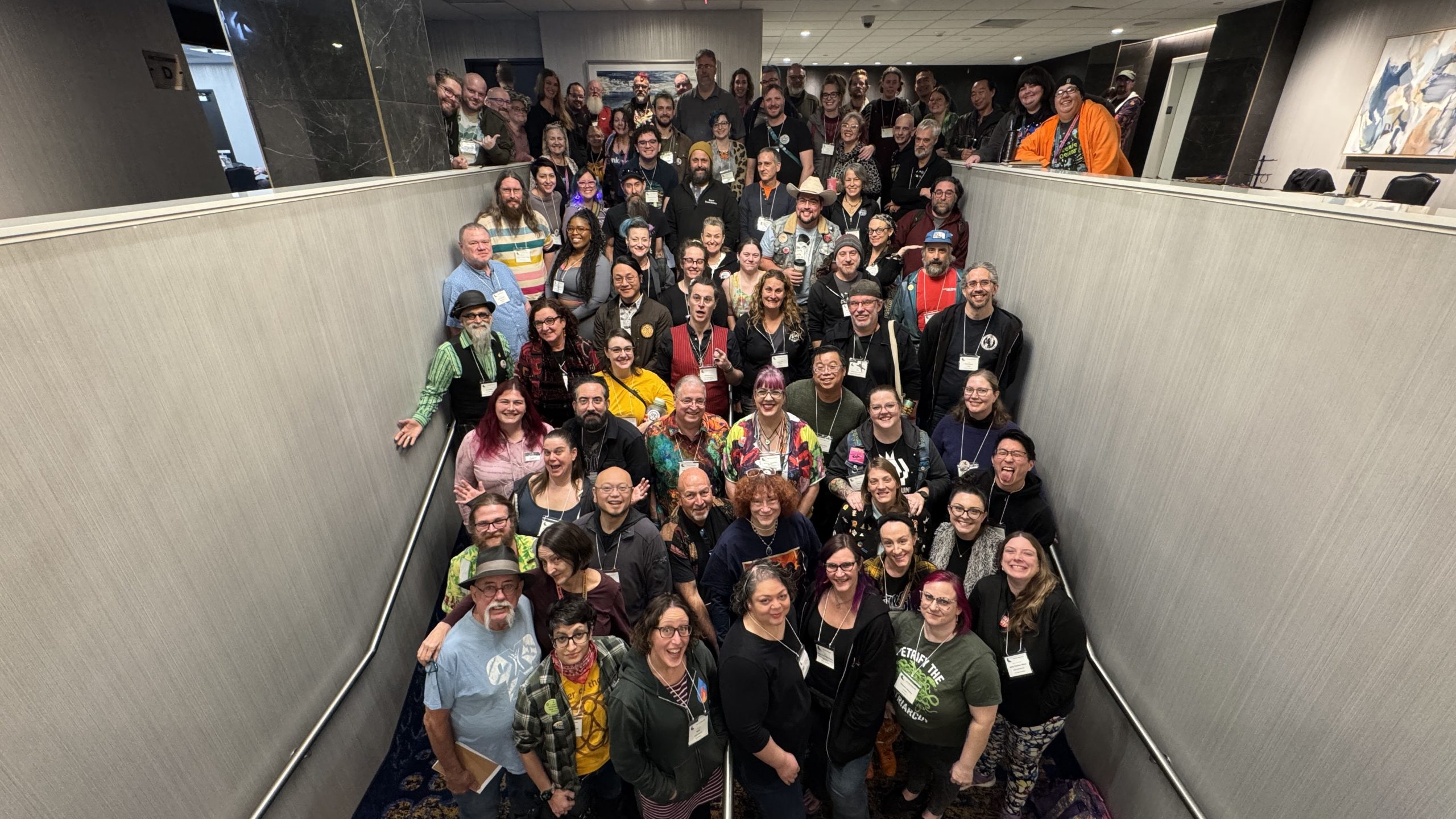
96 people representing at least 18 entities participated.
Ticketing
The ticketing process was the same as in 2024. There were two phases to it:
- A crowdfunding campaign to meet the conference’s basic funding goals. These tickets cost $150.
- General sales after the crowdfunding campaign ended. These tickets cost $185. Buyers could either purchase a ticket for themselves or vouchers for others.
The crowdfunding campaign ran from Feb 21 to Mar 23. The campaign’s target amount was $13,500; it raised $14,750 (not deducting the Indiegogo 8% fee), for 97 tickets (plus a very small amount in donations below the price of a ticket). The goal of the crowdfunding campaign was to meet the conference’s upfront costs in advance, and it succeeded in that, although contributions were off somewhat from 2024.
Backers of the crowdfunding campaign were sent vouchers that they could redeem for tickets. Vouchers were also available for sale during the general-sale period. There were a total of 113 vouchers (as opposed to tickets) sold, either during the crowdfunding campaign or regular sales. Of these, 83 were “group buy” tickets, where one person or (usually) organization bought multiple vouchers, anywhere from 2 to 10.
During general sales, an additional 20 tickets and an unknown number of vouchers were sold.
31 tickets or vouchers went unused. Some backers let us know that they were treating their ticket as a donation; some had purchased vouchers on spec for members of their organization, and then had trouble finding anyone who could use them. For the most part, we never heard from the no-shows.
About five tickets were transferred.
Four vouchers purchased during the crowdfunding campaign were later refunded, not counted in the numbers above.
Setting the ticket price is a tightrope walk: the goal is to be as cheap as possible, but no cheaper; the general-sale ticket price should be a big enough delta over the crowdfunding price that it provided a real incentive to buy early—the only way the conference would go forward—without seeming punitive. The crowdfunding target was 90 tickets-worth. The prices were kept the same as the year before, but the ticket-buying dynamic was a little different, since we barely met our crowdfunding target this time, and only at the last minute. In fact, the conference venue was cheap enough that we probably could have lowered prices this time around.
For an event like BAM, a crowdfunding campaign is a good way to get it off the ground, although it’s probably not ideal for all the organizations that back the event. In 2024, some orgs wound up buying tickets they never used, and the same happened again in 2025, although less so.
Programming
Most of the programming was sessions proposed by participants; two roundtable talks were suggested by the BAM committee to people who had volunteered to facilitate roundtables, and two roundtables were led by members of the committee. Other than that, the organizers were mostly hands-off. BAM is like a burn in this regard: it is what its participants bring.
One presenter wound up having a default-world scheduling conflict, and had to swap time slots with another session after the program went to print.
The conference opened with brief remarks by Adam in the function room where people were having breakfast, followed by an icebreaking exercise. For this exercise, the participants rolled five 20-sided dice when they checked in, and were given five cards with those numbers. The reverse side of the card had a “human scavenger hunt” challenge (for example, “find someone who brought a parent to a burn.”) and participants were encouraged to find as many people as they could who fulfilled the challenge. The winner, with a score of 50, won a golden clipboard. This exercise generally seemed to be well-received, and grew out of a suggestion made by someone else who has run a local leadership event. But making up all the cards was time-consuming.
After that, Saturday had three sessions in parallel and three 85-minute time slots; Sunday was 3×4. There wound up being three holes in the schedule grid.
Unlike 2025, the sessions this year tended to be less operational and more abstract in nature, with topics focusing on volunteerism, inclusion, conflict, codes of conduct. Also unlike 2025, all of the rooms were set up for roundtable-style discussions, and there wasn’t an explicit distinction between presentations and roundtables. This seems like a better fit for BAM. The meeting rooms this year were more than big enough, but space has been tight in the past.
As in 2024 (and inspired by the ELS), we facilitated dine-around dinners. Apart from announcing that we would be facilitating them, there was no advance planning for these: people proposed topics at the event and collected signups at the registration table. These were well-received.
- Accepting less-than-perfect outcomes (late suggestion, zero people)
- When to move location of your burn (7 people)
- Event software for us by us (4 people)
- Sustainable budgets (6 people)
- Ethics of AI (7 people)
- BWB (4 people)
- Burn Medical; Good Samaritan vs duty to act (5 people)
Last year I mentioned that roundtable sessions were run too loosely. Based on what I saw, that problem seems to have been mostly corrected this year. We did have a problem with a few people getting on stack way too much.
An ongoing problem is that we spend a lot of time introducing ourselves to each other. One idea that grew out of the final session was to collect basic 411 information on each participating organization in advance and publish that in the program so we can skip that step.
Speaking of the program, this year (as in past years) we needed to make changes to the schedule after it went to print. I am considering switching to an electronic program only so we can make those last-minute changes. The programs costs about $3 each, so they’re not a big outlay, but printing cost is a consideration. I won’t make this change without getting some feedback from the participants.
Communications
Communications are largely unchanged since last year, so I will keep last year’s section intact below. The one notable change was adding an “extracurricular” channel to the BAM2025 category of channels; this was used very effectively to coordinate outings on the fly.
Pre-event communications between the organizers and participants were via e-mail.
The organizers set up a Discord server for use by the participants, with a general chat channel, a roomshare/rideshare channel, and separate channels for each session. None of these were used much before the conference, but they were used very intensively during the conference, to share documents mentioned during sessions, to share recordings that participants made of the sessions, to organize dinner outings, etc.
The organizers had a Signal group chat that was the primary medium for planning discussions.
I have some misgivings about Discord. It doesn’t really give much control over server membership. It seems to be based on the idea that a server will be more or less public (even though it does nominally allow for private servers), so it offers good tools for banning or muting bad actors, but doesn’t give tools for managing the membership of a private server. People have a single identity across different Discord servers, and don’t need to connect to their default-world identity in any way. Compared to Slack, it does have more powerful options for organizing discussions, and doesn’t hide them after 90 days. So its pros and cons are almost perfectly complementary with Slack.
Discord has a juvenile aesthetic, and is perceived as being the province of The Young, but they do let old farts use it.
Venue & location
We had each meeting room equipped by the hotel with a TV and whiteboard; in one of the meeting rooms, the presenters wound up using the built-in projector instead.
The J Resort is on the site of the former Sands, with guest rooms divided between three towers and the event space on the mezzanine of the middle tower; they are joined by the casino floor. The area surrounding it is somewhat desolate (it is being redeveloped), but there were some dining options within reasonable walking distance. It is not well-served by public transit, and an airport shuttle that it used to run has been shut down. But it’s not a very long ride to the airport, and one of the participants volunteered to act as a shuttle bus with her rental car.
One benefit of being at the J Resort was that we were right on the Neon Line, a series of Burning Man art installations that were bought by the hotel’s owner and installed along 4th St as public art. A member of our committee (Izzi) recruited a local burner guide, who gave us a walking tour of this as our Saturday-night extracurricular activity.
On Friday night, many of us went to The Generator, a burner/burner-adjacent makerspace which coincidentally was having a market that they host every month for their occupants.
On Sunday night, many of us went to the Potentialist Workshop, an experiential art installation that is also burner-adjacent.
It should come as no surprise that Reno has a number of institutions that would be of interest to burners, but it was still gratifying to have something interesting to do each night.
The hotel was OK. The surroundings were neither luxurious nor spartan. Pricing was a good deal, and business dealings with my contact there were surprisingly casual. The fact that our event space was open to the casino floor via a staircase meant that cigarette smoke and noise filtered up.
Catering
The hotel catered breakfast and coffee both days of the conference. Breakfast was a buffet of granola, yogurt, fruit, and various baked goods. Heavy on carbs.
Participant Feedback Highlights
In a post-event survey, participants highlighted the value of connecting across regions, exchanging practical knowledge, and learning from one another’s challenges and successes. Many cited networking, shared problem-solving, and hearing diverse regional perspectives as the most valuable aspects of BAM.
Connection and Networking
- “Connection with other burns, to discuss our experiences, and be able to network for knowledge sharing and training.”
- “Many conversations and roundtables with regional organizers facing some of the same challenges as us.”
- “Connecting with other leaders, seeing the hierarchy of other organizations.”
- “Networking and resource sharing especially around safety and insurance.”
- “Connecting with other regional leaders and learning that our biggest challenges often overlap.”
Sharing Knowledge
- “Open sharing of knowledge and experiences from event leads of vastly different areas and backgrounds.”
- “Passionate people sharing their learnings and engaging in discussion on topics of interest”
- “Was amazing to see and hear from so many different regional perspectives”
- “Hearing potential solutions to problems we have.”
- “Realizing that we have many of the same challenges, and that we have a vast collective knowledge.”
Lessons Participants Will Bring Home
Participants reported leaving BAM 2025 with new tools, shared practices, and knowledge about common challenges.
Volunteerism, Community Support, and Engagement
- “Volunteer incentives, how other burns take care of theirs, also the Code of Conduct committee.”
- “More community events and leaning on other leadership for advice”
- “We need to ask our community for more help. Too few people are trying to do too much, and if we reach out to the community more, we’ll probably get more of what we need.”
- “New ideas for retaining/appreciating volunteers”
Shared Challenges
- “Energy and ideas for driving more activity year-round, confidence in our doing the right thing in a lot of areas, confirmation that some challenges (like an aging population are common), lots and lots of notes.”
- “That some of the issues we are experiencing are being felt globally and are not just unique our Org”
- “That there are many folks working on similar things and we can learn from them.”
- “We are all part of an important social construct. Our work at our regional burn has impacts beyond our event. This is important across the world”
- “Mostly that this stuff is really hard, and everyone struggles with the same thing (especially insurance, volunteerism, and land).”
- “The experiments and successes of other burns; don’t be afraid to build something, fail, tear it down and build again. Town Halls well before an event can be a good way of bringing in new energy and ideas, and getting the word out.”
- “New pitfalls to avoid from lessons learned elsewhere!”
Governance, Policy, and Conflict Resolution
- “New perspectives on planning, coaching, and making space to facilitate tough but necessary conversations.”
- “Reviewing our documentation procedures”
- “The most direct lessons are about insurance and “codes of conduct” (or whatever you want to call it) but getting a preview of what older / larger / more established burns are dealing with and their practices is equally valuable.”
Program
Sessions
Saturday
08:00–9:00
Breakfast & coffee
09:00–10:25
Plenary session: ground rules, icebreaker exercise
10:30–11:55
State of the Regional Network
Members of the Burning Man Regional Events Committee (REC) present highlights from the 2024 Official Event Afterburn Summary Questionnaire and the ARRRs (Regional Contact Annual Regional Recap Reports), sharing insights into global participation, volunteer engagement, sustainability, inclusion, collective impact, and community creativity. Learn how 85 official events in 20 countries continue to evolve—offering art grants, building leadership, addressing challenges, and fostering more collaboration through peer-to-peer learning initiatives.
- Room: Cedar A
- Presenters: Steven Raspa, Corprew “Zeitgeist” Reed, Kristen “Fancypants” Vogt
Harnessing AI Creativity For Burners:
In this interactive, hour-long workshop, join Sara Nicole Glass aka MissConception, creative technologist, educator, community organizer and event expert, to explore how AI tools—especially ChatGPT and other generative platforms—can amplify your creative fire in the Burning Man ecosystem.
Together, we’ll play with practical ways to integrate AI into art projects, theme camp logistics, event design, and storytelling, while keeping the spirit of the Ten Principles alive—especially radical self-expression, communal effort, and decommodification. Participants will experiment with using AI to:
- Spark ideas for immersive art and theme camp concepts
- Streamline event communication, scheduling, and planning workflows
- Generate creative copy, grant proposals, signage, and social media posts
- Collaborate on storytelling, rituals, and community-building projects
- Explore ethical questions around authenticity, consent, and creativity in a digital age
The session includes hands-on demos, live brainstorming, and collaborative play—all designed to help you use AI responsibly, imaginatively, and in alignment with burner values. Whether you’re an event organizer, artist, ranger, or dreamer, you’ll leave with new tools, fresh inspiration, and a renewed sense of creative agency. Helpful but not required: Bring a laptop or mobile device to experiment with live AI prompts during the session.
- Room: Cedar B
- Presenters: Sara Glass
Noon–13:55
Break for lunch
14:00–15:25
Community Outreach Events—Highlighting Our Best Assets
Sometimes the party aspect of burner culture can overshadow the really cool strengths and skill sets that we are all coming together to celebrate in the first place. A few communities have found ways to offset the general public’s fixation on the burner party culture by creating community events that highlight all of the other super cool aspects of burners and burner culture in an open-to-the-public setting. Let’s take a look at one of them, examine the goals and principles behind the event, and brainstorm other formats that these goals and principles might take. How can we inspire more radically inclusive pop-up burner events in more places?
- Room:
- Presenters: Rene Johnson
Finding, Supporting And Retaining Regional Community Leadership
Portland Oregon has an active Burning Man community, supported by our 501c3 (Precipitation Northwest), our regional event (SOAK), our decompression gathering (BurnOn), a weekly social meetup (Woosday), and host of theme camps, artists and other spontaneous collaborations. These activities thrive thanks to individuals who step up to organize, coordinate and create.
How do we find these people? What are the pathways that lead to engagement? How do we keep volunteers inspired and supported, and how do we help them avoid burning out? This facilitated conversation invites participants from across regional communities to explore these questions together. We’ll begin by sharing some recent discussions and strategies from Portland, and then open the floor for others to contribute their experiences, challenges and successes. The goal is to leave with a broader understanding of how different communities are cultivating and sustaining leadership, and a richer toolkit of ideas to bring back home.
- Room:
- Presenters: Chris Schneider
How to prepare for ad-hoc solutions
As organizers, we plan for contingencies for FUN, but we know there will always be unknown unknowns. What tips and tools and practices can we use when we find we need to improvise? This will be a roundtable discussion—bring your ideas.
- Room: Cedar C
- Presenters: Noreen “Izzi” Long
15:30–17:00
Insurance For Burn Orgs – Why Is It So Damn Hard?
The insurance market for our Burn events has taken another turn and it keeps getting tighter. I’m sure you have encountered the daunting task of finding a policy that will insure your Burn and provide any real coverage. It’s certainly not easy, like finding a needle in a haystack. Let’s be real – this insurance crap is as fun as watching paint dry. I feel you and want to make this part of running your org and event as painless as possible.
Many of you already know me (Courtney Weidner aka Deere Bringer) or Rick Diaz, the other burner agent that has been helping our orgs secure event liability coverage for our Burns. In this breakout, we will be discussing the top challenges for our orgs in securing coverage for our events, what makes them undesirable for insurance companies and what we can do about it.
We will also touch on the annual general liability, directors & officers’ liability and accident insurance our orgs need for volunteers, what it’s good for, etc. If you’ve been tasked with finding the best coverage available for your organization, come be part of this discussion and get the info you need to be protected in 2026.
- Room: Cedar B
- Presenters: Courtney Weidner, Anton Erik “Valemon” Vogt
Regional Events And Activities In Germany
Germany has a larger number of small and mid-sized burn-style events around the year and many other activities of burners in various groups. I will describe the landscape, organisations and adventures and mention challenges and positive experience. the.burn.directory has been created by the Munich RC, it represents a local to global offer to list, detail and find events and groups in the past, present and future. – Room: Cedar C – Presenters: Jörg Pfützner
Regional Ranger Roundup Returns
This is a conversational session for regional rangers to get together and talk about things in the last year.
- What’s been going well at your regional?
- What hasn’t been going well?
- What have you learned
- What do you need? / What would you suggest?
Regional Rangers hold a session at Burning Man every year and also at BAM to talk about how things are going at their events, as a community.
- Room: Cedar A
- Presenters: Chris Schneider, Corprew “Zeitgeist” Reed
Sunday
08:00–9:00
Breakfast & coffee
09:00–10:25
Getting art out into the world
This roundtable invites us to explore how burner-created art can flourish beyond event boundaries. Participants will discuss pathways for supporting artists year-round, including community partnerships, public installations, touring works, grants, and more. The session focuses on practical strategies, successes, and the unique challenges of bringing participatory, interactive art into wider civic and cultural spaces.
- Room: Cedar C
- Presenter: Kay Morrison
Regional Event Civic Ignition Grant Workshop | A BWB Participatory Grant Making Experience For Bold, Community-Driven Ideas
The Regional Event Civic Ignition Grant Workshop is a collaborative, hands-on session where participants come together to review, discuss, and award funding to innovative civic projects rooted in Regional Events and 10 Principles-aligned gatherings. This workshop isn’t just about selecting a winner—it’s about sparking dialogue, building relationships, and exploring how our events can better each other through radical creativity, innovative ideas, and collaboration. Participants will:
- Review real project proposals submitted by fellow community members
- Engage in group discussion using consensus-based decision-making
- Award up to $1,500 in microgrants to one or more selected projects
Help shape the future of civic innovation within the Regional Events and 10 Principled aligned gatherings.
Whether you’re a longtime organizer or new to grant administration, this is a chance to witness community-led grantmaking in action—and to help fund projects you’d want to see at your local events. Learn more about the grant here: https://burnerswithoutborders.org/uncategorized/2025-regional-event-grant/
- Room: Cedar B
- Presenters: Jaymie Braun
Conflict Management And Potential Best Practices
Conflict is inevitable in any collaborative community, but how we handle it defines our culture. Join us for a conversation on conflict management and possible best practices–including DIY approaches–as we consider how we might level up our community’s approach to conflict response and resolution. We’ll discuss what kinds of tools and approaches might be helpful for addressing conflicts; and invite participants to share resources and success stories. Together, we’ll begin identifying best practices to shape a community-driven framework for conflict resolution that helps all of us navigate challenges with clarity, compassion, and curiosity.
- Room: Cedar A
- Presenters: Kristen “Fancypants” Vogt
10:30–11:55
Code of Conduct or Code of Culture? Exploring Governance, Safety, and Community Agreements in Regionals
Regional burns are at evolving. While Black Rock City operates without a formal Code of Conduct—relying on the 10 Principles, shared culture, Rangers, and the Survival Guide—many regionals have begun adopting CoCs and behavioral agreements. Why? What needs are they trying to meet? And how do we do this without drifting into bureaucratic culture, default-world enforcement energy, or fear-based governance?
In this discussion, we’ll explore the role Codes of Conduct can play in nurturing safety, accountability, and inclusion at regional events—without eroding autonomy, radical participation, improvisation, and trust. We’ll look at what belongs in a culture-forward Code (if anything), what belongs in internal safety processes instead, and when “more policy” is not the right answer.
Key questions we’ll consider:
- Do regionals need Codes of Conduct, or are the 10 Principles + Survival Guide + Rangers enough?
- If we do adopt one, what should it look like? Culture-forward? Administrative? Both?
- How do we support consent, respect, and safety without building a compliance culture?
- Where’s the line between community accountability and default-world paternalism?
- What are alternatives—community agreements, norms, or values statements?
- How do we preserve burner magic while supporting safety, volunteers, and legal reality?
This is not a lecture—it’s a collaborative inquiry into how we protect the culture while protecting the humans, and how regionals can evolve governance in ways that feel aligned, permission-less, and still grounded in care.
Bring your experience, your questions, your fears about policy creep, and your hopes for a future where we can be radically expressive and radically respectful, without losing the fire.
- Room: Cedar A
- Presenters: Anton Erik “Valemon” Vogt
Staffing & Participation Challenges Forum
An open discussion on two of the most common challenges regional events face: staffing and participation. We’ll explore examples and share practical tips for recruiting and retaining volunteers, cultivating leadership, and increasing engagement across your community. Participants will exchange ideas, highlight successes, and contribute to a growing pool of shared knowledge.
- Room: Cedar B
- Presenters: Edwin Corprew Reed, Benson “Venture” Ho
Environmental Sustainability At Regional Events
This session is an invitation for regional event organizers, sustainability leads, and anyone passionate about making their gatherings more environmentally sustainable. Together, we’ll explore how regional events are approaching sustainability, from reducing waste and emissions to fostering local partnerships, renewable energy use, and Leave No Trace practices.
The session’s goals are twofold:
- To cultivate a connected network of leaders who are driving sustainability at their regional events.
- To create space for shared learning, where participants can both teach and discover practical solutions that are working in different regions and contexts.
Whether your event is just starting to think about sustainability or already has years of experience, this conversation is for you. Bring your stories, challenges, and ideas as we build collective momentum towards sustainable and regenerative regional events.
- Room: Cedar C
- Presenters: Stephen Chun
Noon–13:55
Break for lunch
14:00–15:25
Fostering small art
Art at Burning Man is BIG. Most regional events don’t have the space or infrastructure to host really large art, but they’re the perfect place for smaller projects.
How does your regional community encourage more art? In this roundtable, we’ll share ideas on how your community fosters art on a smaller scale.
- Room: Cedar B
- Presenters: Susan Shelton
Roundtable: Safety departments’ interactions with artists – and with other departments
Let’s talk about best practices, and creative ideas for how we, as safety volunteers, balance creativity with ‘safety’. How does that conversation happen with creative types? How do we show up, support, educate other departments? What is our role in evaluating risk, guiding good decisions, while still encouraging immediacy, self reliance, atonomy?
- Room: Cedar A
- Presenters: uniKornicator
Radical Welcome: Our Path To Inclusion
Over the past two years, SOAK Oregon’s Regional Burning Man event has taken steps toward deeper inclusion and accessibility inspired by Radical Inclusion. This session will explore how our event has grown accessibility programs like the SOAK Train, Radical Inclusion Ticket Program, and Subsidized Ticketing; each aiming to reduce barriers to participation and create a more equitable Burn.
We’ll share what’s worked, where we’ve stumbled, and how we’ve engaged departments across the event to reflect on their own diversity, equity, and inclusion (DEI) practices. From practical site adaptations to legal considerations and community-centered design, you’ll hear takeaways from us around efforts to include first-timers, BIPOC participants, differently abled community members, and those with limited income.
We’ll also look ahead to SOAK’s next evolution: integrating accessibility efforts under a unified Radical Inclusion department. Join us for stories, strategies, and real-world lessons from the valley in Oregon.
- Room: Cedar C
- Presenters: Caitlin May, Juliana Wallace
15:30–17:00
Connecting the community year round
If we’re just getting together for a party once a year, we’re not much of a community. How do we build that community the rest of the year?
- Room: Cedar B
- Presenter: Mike “Clovis Buford” Watkins
Speakers
Anton Erik “Valemon” Vogt
After four years as Apogaea Prez, I stepped into a role supporting finances and procuring insurance. Insurance, as we all know, has gotten much harder to procure these past few years and there are definitely things we can do to reduce risk and help ensure we can keep underwriters happy. This year I’ll be joined by two industry experts to talk about the industry, what to look for in policies, trends in permitting requirements, share best practices, and brainstorm ways of making sure our events have the coverage we need. My other job is being Fancy Pant’s emotional support animal.
Sessions: Code of Conduct or Code of Culture? Exploring Governance, Safety, and Community Agreements in Regionals; Insurance For Burn Orgs – Why Is It So Damn Hard?
Chris Schneider
Starfish grew up in Ohio, then relocated to Portland around the turn of the century. He attended his first Burning Man in 2008 and began attending SOAK in 2012. Starfish enjoys building art and then responsibly setting it on fire. He’s been involved in multiple burnable art projects (and a few non-burnable as well). He was a SOAK Producer from 2015-2017 and volunteers as a Black Rock Ranger as well as with other departments.
The 10 principles that he most values are: Decommodification, Radical Inclusion, and Communal Effort; also Leave No Trace for purely practical reasons.
Sessions: Finding, Supporting and Retaining Regional Community Leadership, Regional Ranger Roundup Returns
Corprew “Zeitgeist” Reed
Black Rock Ranger & Member of Regional Events Committee
Sessions: Regional Ranger Roundup
Courtney “Deere Bringer” Weidner
Courtney Weidner is a burner insurance nerd, Connector & Life Catalyst who loves cats, coffee, butterfly gardening and nature photography. ENFP, S/c on DISC, Enneagram sx2, Human Design Generator 4/6, Life Path 9, ADHD, Pisces, dreamer.
She attended her first regional Burning Flipside in 2014 and knew instantly – she’d found Home. Volunteer to her core, she’s worked as a zone czar, DaFT, VAS, perimeter line and is forever an Earth Guardian, currently serving as Clean Up Lead and a listener for Sanctuary at Flipside 2024.
Her default career for the last 26 years has been working as an agent with Farmers Insurance. She acquired the family business in 2007 and in September 2023, she fully retired from Farmers and launched her new commercial independent agency, EverSecure Insurance Solutions.
Courtney is now assisting regional burns with their insurance needs across the country. Her professional experience and insight into how burns operate give her a unique position to understand the risks and exposures at regional burns. She knows first-hand how restrictive the insurance market has become and how difficult it is to find coverage for our organizations. She will be leading a discussion on insurance needs and provide options as to what we can do to collaborate on solutions.
Sessions: Insurance For Burn Orgs – Why Is It So Damn Hard?
Jaymie Braun
Jaymie first volunteered with BWB Sacramento as a project translator. Having a passion and drive for the work, she soon became the BWB Project Manager. Jaymie supports the BWB team in fulfilling their mission to make a positive impact around the world. She finds herself inspired by individuals who are willing to stand out and be the difference in their communities and has a small obsession with composting toilets.
Sessions: Regional Event Civic Ignition Grant Workshop
Jörg Pfützner
Burning since American Dream. Freelance engineer, globetrotter. Engaged / involved with many org teams in BMP and in Europe. Supporting burner art on playa and at regionals. Producing German leadership conference (Burn More) Producing the official German burn Art Baer [ www.artbaer.de ] Regional contact (1/5) for Germany (Leipzig) Attended the ELS since its inception in 2014. Enthusiastic networker, weaver and connector. Ambitious amateur photographer. Grumpy old man.
Sessions: Regional events and activities in Germany
Juliana Wallace
Juliana Wallace spends her weekdays running behavioral health programs for people experiencing homelessness and her weekends (and weeknights) trying to make a dusty, joy filled camping adventure more accessible to literally everyone. She believes in radical inclusion, equitable ticketing, and the power of forms to avoid spreadsheet design. At SOAK, she helps wrangle cats, tickets, and the occasional well-meaning chaos all in the name of getting more humans to the 10 principles in practice.
Sessions: Radical Welcome: Our Path to Inclusion
Kristen “Fancypants” Vogt
Kristen (aka Fancypants) is a former board member, secretary, and Ticketing Lead for Apogaea, and currently serves as Permit Lead. She is also the Project Manager for the Burning Man Regional Events Committee. The committee is a resource of knowledge and support for the ongoing development of official regional events within the Burning Man Regional Network. On playa, she works with Playa Info and Lost and Found, and sometimes assists Census with data entry. Kristen is a librarian nerd who loves to help behind the scenes with “creating the container” so that our brilliant Burner communities can do all of their amazing things.
Sessions: State of the Regional Network; Conflict Management And Potential Best Practices
Mike “Clovis Buford” Watkins
Sessions: Connecting the community year-round
Rene Johnson
My main drive is to foster spaces where people of diverse disciplines and interests can gather and learn from each other, and with each other, to produce the sense of belonging and support that is the foundation of all things creative.
Sessions: Community Outreach Events—Highlighting Our Best Assets
Sara Glass
Sara Nicole Glass, also known as the artist “Miss Conception” is a poet, DJ, fire spinner, performance artist, event planner and educator, based out of Kansas City, with ties to the Bay Area. Her work with BWB, the Community Events Team, and as a theme camp leader of Pandora, all collide at Burning Man.
Sessions: Harnessing AI Creativity For Burners
Stephen Chun
I’m Stephen “Babies & Gentle Man” Chun (he/him). I am a project manager working on sustainability initiatives with Burning Man Project. I collaborate with Burning Man departments and participants groups to take Black Rock City off of fossil fuels and execute sustainability projects. I am a father of twin toddlers and I like to ride bicycles. I cycled for 7 days from San Francisco to Black Rock City! My mission is to improve life for humans, animals, and plants.
Sessions: Environmental Sustainability at Regional Events
Steven Raspa
Steven Raspa is Associate Director Community Events for Burning Man. He is a founding member of the Regional Network Committee and the Regional Events Committee; and supports the process of annual official Regional Event recognition for Burning Man. He is also an arts advocate and often speaks about Burner culture, the 10 Principles and their application for cultural policies, nightlife and urban planning.
Sessions: State of the Regional Network
Susan Shelton
A Camp Cosmos co-leader and occasional Ranger who volunteered to help with the Flipside Flame, then became Content Lead, then Site-Prep AF before joining Catalyst Collective for the 2023 event year.
Sessions: Fostering small art at burns
uniKornik8r
I’ve attended the big burn in 2005, 2008, 2012 and 2014 – theme camps Mischief Camp and Late Nite Schlong. I’ve been at every Apo since 2005 except 2016 & 2017 – took a couple years off after we didn’t hold Apo in 2015. My main volunteer interest has been with fire safety. My art interests are currently focused on propane flame effects.
Sessions: Roundtable – Safety departments’ interactions with artists – and with other departments